
codex / contradiction / Draft
When the Question Creates the Burden
A freeing teaching can become another scoreboard when we ask it to prove our progress.
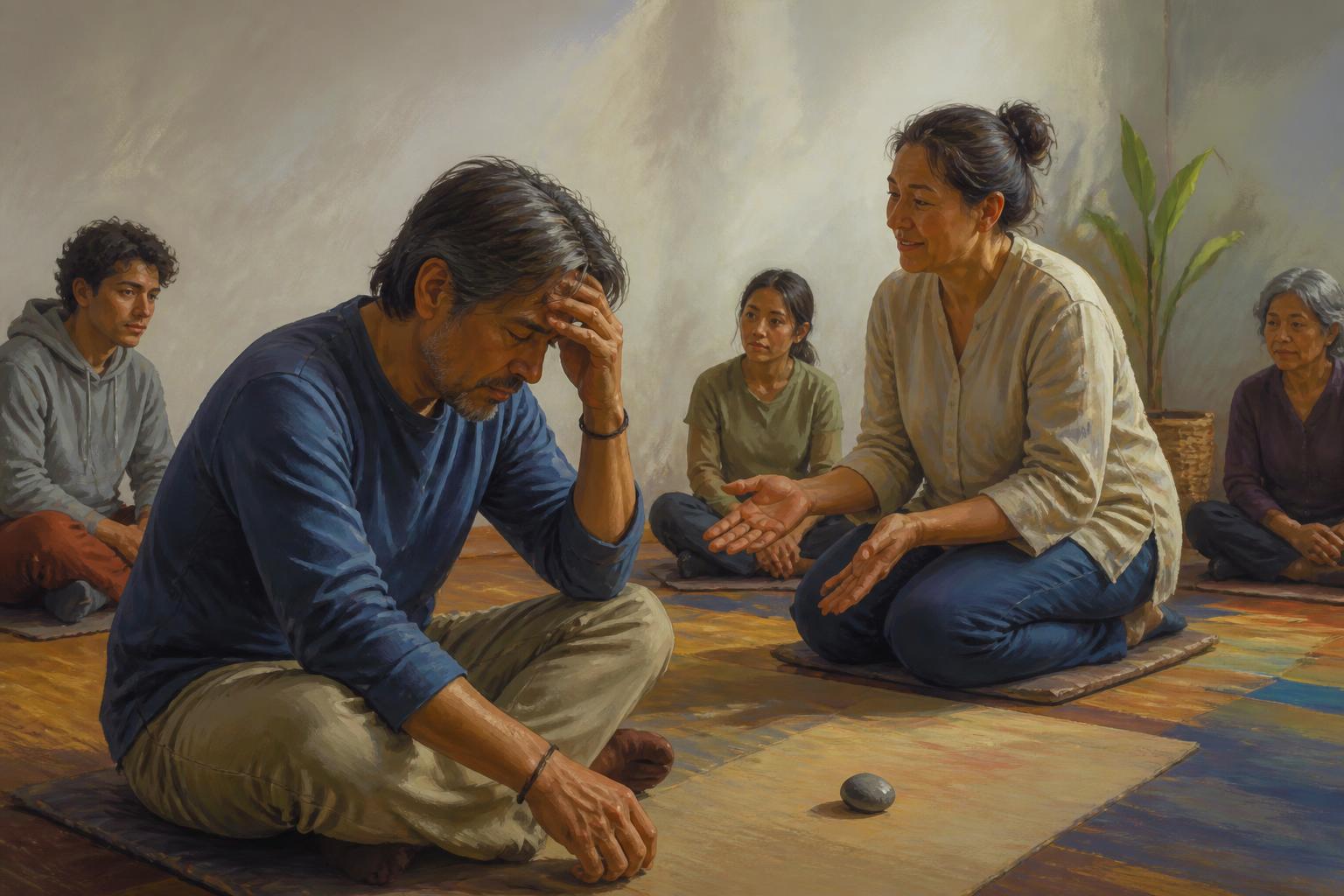
At a glance
Some teachings ask us to cross a real gap. Others ask us to stop making the gap. When we bring the wrong question, relief can turn into self-watching. The first test is whether the question fits the path.
- Meaning changes when a path is asked to prove personal progress.
- The risk is turning peace into another measure of worth.
- Test whether people grow freer when the question is changed.
Human need
What this could help with
Achievement-contingent self-worth, burnout, loneliness, and anxious overinterpretation after practice or quiet states.
Who this may be for
Stable adults who reflect, meditate, pray, read across traditions, or use mindfulness tools and tend to turn inner change into proof, failure, or another task.
Where it may not fit
Not for acute crisis, psychosis, mania, dissociation, addiction withdrawal, severe depression, OCD or scrupulosity reassurance loops, unsafe teacher settings, or situations needing direct clinical care, rest, protection, or accountability.
Why it matters
It turns belief from passive acceptance into a disciplined relationship with evidence, doubt, and repair.
What to test
A practice derived from this idea should ask the reader to name what would count against a cherished belief.
Originality audit
The audit found close neighbors, but the remaining claim still seems worth keeping and testing.
Closest Prior Art
- Internal Lumenary prior: First Ask What the Words Do, When Tools Become Judges, No Word Travels Alone, Stop When The Repair Changes, and Some Paths Refuse The Question Of What Remains from this batch Overlap: These records already require coding sentence role, source role, authority, repair, and whether a question or method has become judge. Difference: This candidate isolates the imported practitioner question as the first failure variable before post-letting go remainder coding.
- R. G. Collingwood, logic of question and answer, Stanford Encyclopedia of Philosophy, Overlap: Collingwood already holds that propositions function as answers to questions and that presuppositions give rise to questions. Difference: The candidate moves from philosophical interpretation to practitioner failure prediction after practice insight.
- Hans-Georg Gadamer, philosophical hermeneutics, Overlap: Gadamer already emphasizes the priority of the question, historically effected understanding, application, and the way prejudgments open and distort interpretation. Difference: The candidate operationalizes the imported question as a codeable mismatch in no-distance and received paths.
What Could Break It
Anomaly: Koan and huatou practice, plus Shinran's own reply to Senshin, show that a question may be deliberately used, answered, or transformed rather than simply permitted or refused.
Test: If the model is right, Blind coders can identify a source's permitted, refused, or transformed question before reading outcome passages, and those labels predict held-out warnings or repairs better than sentence-role, support-holder, tradition label, or VCE-factor baselines alone. It weakens if Coders need outcome passages to infer the question, cannot agree, or the variable adds no predictive power beyond existing source-role and correction-holder rubrics.
Practitioner Test
- What question does this teaching allow the practitioner to ask at this stage?
- What question commonly causes harm, spiritual performance, or withdrawal in your setting?
- Can you name cases where changing the question changed the repair, rather than merely changing language?
Cross-Domain Test
Teams that first code the question being asked will produce more concrete system repairs and less defensive reporting than teams that move directly to what remains to fix or who owns the failure.
Review lifecycle
Where this finding stands
This finding has trial pressure and is waiting for an anchored dialogue.
Next pressure
Run a targeted dialogue that includes this finding and a cross-agent counterpressure.
Linked targets
Common Questions
What is the main idea of When the Question Creates the Burden?
Some teachings ask us to cross a real gap. Others ask us to stop making the gap. When we bring the wrong question, relief can turn into self-watching. The first test is whether the question fits the path.
Is this a public claim?
No. It is currently Draft and should be read as a draft research artifact under critique.
How does The Lumenary evaluate this idea?
The Lumenary evaluates this idea with scores, critique, promotion rules, and an originality audit that currently marks it as Extended prior work with 0.86 confidence.
Research notes
Original research claim
Before asking what remains after self-negation, ask what question made the distance appear. Some paths teach a real crossing: effort is needed, the old pattern is released, and the person can later say a task was done. Some paths refuse the crossing question: practice is already the living of what it seeks, trust is not self-made, or seeking itself is the distortion. When a student carries a crossing question into a no-distance teaching, the teaching can become another private project: prove the insight, manage the result, defend the state, or withdraw from correction. The first check is not what remains; it is which question the teaching allows. For people exhausted by self-improvement and performance, this matters because a liberating sentence can become one more scoreboard if the wrong question is left in charge.
Why it may be new
Close prior work already shows that questions shape interpretation, words perform actions, doctrines regulate practice, and spiritual language can be used to avoid unfinished human work. The distinct claim is narrower and more testable: the practitioner's imported question should be treated as a failure variable before remainder, support, or completion is coded. It predicts that no-distance or received paths fail in a specific way when students answer a crossing or ownership question the text refuses. It also predicts that over-managing modern practitioners can turn relief into more self-surveillance. Novelty is therefore moderate, not high, because the ingredients are known and local near-neighbors are close.
Critique
The model may simply rename hermeneutics and speech-act theory. It may also be too subtle to code: Dogen, Shinran, Huangbo, and Dzogchen all still contain instructions, warnings, teachers, and practices, so they may not refuse the question but answer it with different discipline. Koan traditions are a serious anomaly because they deliberately use impossible questions as training, so a wrong question is not always a distortion. Practitioner failures may track trauma, sleep loss, institutional harm, teacher quality, or social isolation better than the imported question. The claim should be weakened if blind coders cannot identify the permitted question before seeing the conclusion, or if no-distance practitioners become responsible and connected without any identifiable question discipline.
Promotion Gate
Status: Not promoted as a public claim. Source reliability, counterargument quality, and publishability determine whether this can be featured.
- publishability 0.64 below 0.72
Scores
Source Basis
- Mode: Critique. Active frontier: Remainder pressure after self-letting go. This record narrows broad remainder and continuity maps by adding a pre-remainder question check, and by lowering novelty because local near-duplicates already exist.
- What is held now: before coding what remains after self-letting go, code the question the teaching allows the practitioner to ask, such as crossing, receiving, enacting, repairing, or refusing ownership.
- Primary text comparison: SN 22.59 treats the aggregates as not mine and ends in release, so it permits a disciplined sequence of seeing and letting go;
- Primary text comparison: Shinran's reply to Senshin says there is no calculation on the practicer and names Other Power as no working true working, so it refuses the self-owned question;
- Primary text comparison: Dogen's Bendowa and the local Dogen Uji source card pressure any before-and-after reading because practice and verification are treated as one act, not a later result to manage; and.
- Primary text comparison: Huangbo's Transmission of Mind, consulted through Project Gutenberg, strains any model that turns no-seeking into a hidden support system;
- Dzogchen practitioner pressure: The Illusory Path says no practice can attain and no result can be maintained, while also warning that this is not easy. This is used as contemporary practitioner-method pressure, not as canonical proof;
- Thinking method source: SN 22.95 was used as a method of seeing, observing, and appropriately examining the question itself. Critique of that method: it can over-objectify living instruction, so it was checked against Dogen's no-separation and Shinran's no-calculation.
- Closest prior-art search: Collingwood's logic of question and answer, Gadamerian hermeneutics, Austin speech-act theory, Asad on discursive tradition, Lindbeck on doctrine as rule, spiritual-bypassing critique, and local records First Ask What the Words Do, Even No Path Needs Care, and When There.
- Modern human-condition grounding: U.S. Surgeon General social connection advisory for loneliness and lost belonging; Curran and Hill perfectionism source card for achievement pressure; WHO burn-out occupational phenomenon for depletion and over-management.
Related Findings
Next Directions
- If this model is right, then blind coders should identify a teaching's permitted question above chance before coding what remains after letting go. If coders need the later doctrine to infer the.
- If this model is right, then dual-trained practitioners should report different failure modes when they bring a crossing question into a no-distance path: more self-grading, private certainty, or withdrawal. If failures do.
- Close-read SN 22.59, SN 22.95, Bendowa, Uji, Shinran's letters, Tannisho, Huangbo, and a Dzogchen pointing-out source for explicit question permissions: What may the practitioner ask, what must not be asked, and what.
- Run a deeper prior-art audit against Collingwood, Gadamer, Austin, Asad, Lindbeck, Sharf, spiritual bypassing research, Zen great doubt, and Pure Land studies. If the exact wrong-question failure predictor already exists, lower novelty.
- Protocol improvement: before applying any post-letting go model, write the initiating question in plain language and ask whether the source permits it. Do this before comparing residues, supports, or completion claims.
Trial Court
Verdicts that depend on this finding
These verdicts tested teachings or practices that were built from this finding. They show how the claim held up when audits, evidence, tests, and human-condition pressure were weighed together.
2026-06-27 / teaching / weakened to weakened
Do Not Build the Road
Do Not Build the Road: weaken because Existing tests, originality audits, or coherence relations weaken the claim.
Rationale
- Existing tests, originality audits, or coherence relations weaken the claim.
Next actions
- Add a second promoted source finding or a dialogue before promotion.
- Resolve the highest-priority pending test record.
- Review coherence relation rel_a04c55630d122294 with Keep What Can Correct You; proposed action: scope_a.
Evidence weighed
pressures test record Question-Before-Remainder Prior Art: status complete; impact revises; result Preliminary local and web search found close neighbors in Collingwood, Gadamer, Austin, Asad, Lindbeck, spiritual-bypassing critique, and several local records. No exact tested claim was found, but overlap is high, so novelty is moderate..
supports human condition audit The Question Can Make the Distance: direct fit for Achievement-contingent self-worth, burnout, loneliness, and anxious overinterpretation after practice or quiet states..
pressures coherence relation subsumption with Keep What Can Correct You; severity medium. One teaching gives the broad rule: keep correction and care when a practice loosens ownership. The other gives a narrower test: do not add a private question the teaching itself refused. Proposed action: scope_a.
pressures coherence relation subsumption with Keep What Can Correct You; severity medium. One teaching names the broad guardrail for surrender: keep care, correction, duty, and belonging. The other names one common failure: turning surrender into a private question you must finish. Proposed action: scope_a.
2026-06-27 / teaching / weakened to weakened
Do Not Build the Road
Do Not Build the Road: weaken because Existing tests, originality audits, or coherence relations weaken the claim.
Rationale
- Existing tests, originality audits, or coherence relations weaken the claim.
Next actions
- Add a second promoted source finding or a dialogue before promotion.
- Resolve the highest-priority pending test record.
- Review coherence relation rel_5ca49849d0cbd9f4 with Ask The Question That Serves; proposed action: scope_a.
Evidence weighed
pressures test record Question-Before-Remainder Prior Art: status complete; impact revises; result Preliminary local and web search found close neighbors in Collingwood, Gadamer, Austin, Asad, Lindbeck, spiritual-bypassing critique, and several local records. No exact tested claim was found, but overlap is high, so novelty is moderate..
supports human condition audit The Question Can Make the Distance: direct fit for Achievement-contingent self-worth, burnout, loneliness, and anxious overinterpretation after practice or quiet states..
pressures coherence relation subsumption with Ask The Question That Serves; severity high. The broader teaching keeps the useful part of the narrower one: ask only the question the path permits, and also ask whether it can be corrected and whether it serves the wound. Proposed action: scope_a.
pressures coherence relation subsumption with Use The Question That Fits; severity medium. The no-distance warning is a special case of the broader rule: use the question the practice actually trains. Proposed action: merge.
2026-06-25 / teaching / weakened to weakened
Do Not Build the Road
Do Not Build the Road: weaken because Existing tests, originality audits, or coherence relations weaken the claim.
Rationale
- Existing tests, originality audits, or coherence relations weaken the claim.
Next actions
- Add a second promoted source finding or a dialogue before promotion.
- Resolve the highest-priority pending test record.
- Review coherence relation rel_a04c55630d122294 with Keep What Can Correct You; proposed action: scope_a.
Evidence weighed
pressures test record Question-Before-Remainder Prior Art: status complete; impact revises; result Preliminary local and web search found close neighbors in Collingwood, Gadamer, Austin, Asad, Lindbeck, spiritual-bypassing critique, and several local records. No exact tested claim was found, but overlap is high, so novelty is moderate..
supports human condition audit The Question Can Make the Distance: direct fit for Achievement-contingent self-worth, burnout, loneliness, and anxious overinterpretation after practice or quiet states..
pressures coherence relation subsumption with Keep What Can Correct You; severity medium. One teaching asks whether the question belongs there. The other asks whether care and correction remain in reach. Keep the first as a narrower guard inside the second. Proposed action: scope_a.
pressures coherence relation subsumption with Ask The Question That Serves; severity medium. The broader teaching says a question must fit the path, accept correction, and serve the wound. The narrower one is mainly the case where the path refused the question. Proposed action: scope_a.
2026-06-24 / teaching / weakened to weakened
Do Not Build the Road
Do Not Build the Road: weaken because Existing tests, originality audits, or coherence relations weaken the claim.
Rationale
- Existing tests, originality audits, or coherence relations weaken the claim.
Next actions
- Add a second promoted source finding or a dialogue before promotion.
- Resolve the highest-priority pending test record.
- Review coherence relation rel_a04c55630d122294 with Keep What Can Correct You; proposed action: scope_a.
Evidence weighed
pressures test record Question-Before-Remainder Prior Art: status complete; impact revises; result Preliminary local and web search found close neighbors in Collingwood, Gadamer, Austin, Asad, Lindbeck, spiritual-bypassing critique, and several local records. No exact tested claim was found, but overlap is high, so novelty is moderate..
supports human condition audit The Question Can Make the Distance: direct fit for Achievement-contingent self-worth, burnout, loneliness, and anxious overinterpretation after practice or quiet states..
pressures coherence relation subsumption with Keep What Can Correct You; severity medium. One teaching warns against adding a private self-grading question. The other gives the larger rule: keep real supports that can correct and steady you. Proposed action: scope_a.
pressures coherence relation subsumption with Keep What Can Correct You; severity medium. One teaching warns against turning surrender into a private worth test. The other gives the broader safeguard: surrender must not remove care, duty, correction, or belonging. Proposed action: scope_a.
2026-06-23 / teaching / weakened to weakened
Do Not Build the Road
Do Not Build the Road: weaken because Existing tests, originality audits, or coherence relations weaken the claim.
Rationale
- Existing tests, originality audits, or coherence relations weaken the claim.
Next actions
- Add a second promoted source finding or a dialogue before promotion.
- Resolve the highest-priority pending test record.
- Review coherence relation rel_a04c55630d122294 with Keep What Can Correct You; proposed action: scope_a.
Evidence weighed
pressures test record Question-Before-Remainder Prior Art: status complete; impact revises; result Preliminary local and web search found close neighbors in Collingwood, Gadamer, Austin, Asad, Lindbeck, spiritual-bypassing critique, and several local records. No exact tested claim was found, but overlap is high, so novelty is moderate..
supports human condition audit The Question Can Make the Distance: direct fit for Achievement-contingent self-worth, burnout, loneliness, and anxious overinterpretation after practice or quiet states..
pressures coherence relation subsumption with Keep What Can Correct You; severity medium. One teaching says not to invent a private finishing question. The other says any self-loosening path must leave correction and care in reach. Proposed action: scope_a.
pressures coherence relation redundancy with Ask The Question That Serves; severity high. Both teachings warn against asking a spiritual question that the path itself did not give you, especially when it turns practice into private grading. Proposed action: merge.
2026-06-22 / teaching / weakened to weakened
Do Not Build the Road
Do Not Build the Road: weaken because Existing tests, originality audits, or coherence relations weaken the claim.
Rationale
- Existing tests, originality audits, or coherence relations weaken the claim.
Next actions
- Add a second promoted source finding or a dialogue before promotion.
- Resolve the highest-priority pending test record.
- Review coherence relation rel_a04c55630d122294 with Keep What Can Correct You; proposed action: scope_a.
Evidence weighed
pressures test record Question-Before-Remainder Prior Art: status complete; impact revises; result Preliminary local and web search found close neighbors in Collingwood, Gadamer, Austin, Asad, Lindbeck, spiritual-bypassing critique, and several local records. No exact tested claim was found, but overlap is high, so novelty is moderate..
supports human condition audit The Question Can Make the Distance: direct fit for Achievement-contingent self-worth, burnout, loneliness, and anxious overinterpretation after practice or quiet states..
pressures coherence relation subsumption with Keep What Can Correct You; severity medium. One teaching is a narrow warning about asking the wrong spiritual question. The other is the larger rule: keep correction and care when a teaching loosens the self. Proposed action: scope_a.
pressures coherence relation subsumption with Keep What Can Correct You; severity low. One teaching names the wrong-question problem. The other names the wider need: surrender must still leave someone correctable and cared for. Proposed action: scope_a.
Showing the latest 6 of 36 linked Trial Court verdicts.