
Teaching candidate / retired / strength 25 / 100
When something shifts in practice, ask who you trust to tell you what it was.
The meaning of a practice experience is not delivered by the practice that produced it. It is named by the people, traditions, or teachers whose judgment the practitioner actually accepts. When no such judgment is available, the absence is itself part of the experience and should be carried with the experience, not in its place.
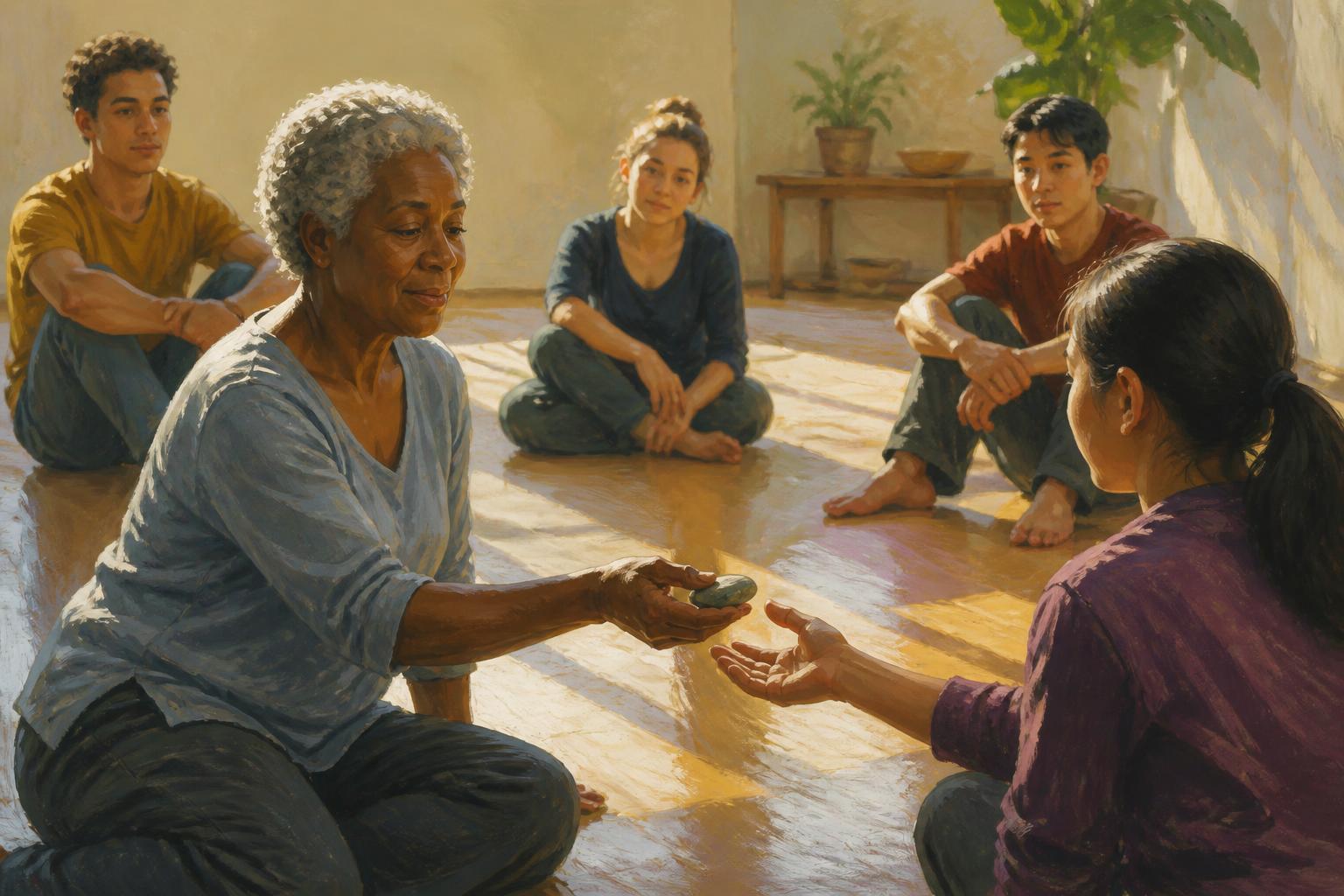
The Teaching
A method gives you something to do. It does not arrive with a label for what just happened. You may feel you saw through self, touched grace, recognized awareness, or finally stopped trying. The method will not tell you which of these is true. Someone else has to, and that someone has to be a person whose judgment you would actually let correct you. Without that, the question of what just happened stays open. Open is not the same as broken. It is honest. Hold the experience. Hold the interpretation loosely. Notice when there is no one who could tell you that you were wrong; that absence is part of what you found.
Human problem
What this is for
Self-directed spiritual practice without recognition partners. People who read across traditions, sit alone, attend retreats with no continuing teacher, or left religious community while keeping the practice. After a meaningful shift, they have no one to honestly name what happened, and they either inflate the experience into identity or doubt it into nothing.
Modern human condition sourcesFor
Who may need it
Modern self-directed seekers, app meditators, weekend retreatants without continuing relationships, readers of between traditions spiritual material, people who left religious communities but kept practice practice, and serious solo practitioners.
Pressure survived
Why it stands for now
Survives the contrast between MN 22's raft, which validates then asks for release inside a sangha that will recognize crossing, and Dogen's practice-realization unity, which authorizes the present act inside transmission and sangha confirmation. Both keep permission communal even when the doctrinal pattern differs. Also survives intra-one path tension between svaprakasha and shabda pramana, which already shows that even self-confirming methods rely on testimony.
Linked Practices
Tests
Recognition gap report from solo practitioners
Solo practitioners in the target cohort who use the Recognition Gap practice three times after meaningful sessions should report that naming the absence of a recognition partner reduces inflation of the experience and reduces oscillation between certainty and doubt. If reports show increased shame, paralysis, or disengagement, the practice fails and the underlying doctrine claim needs revision about who the teaching is for.
Next: Collect short structured reports from at least eight solo practitioners outside acute clinical contexts, asking specifically about interpretation oscillation, identity inflation, and how the gap was carried.
Evidence Trail
Source Basis
- Doctrine mode chosen because the active frontier asks what Lumenary now holds about method authority, and a prior Codex finding (Holding Without Owning) has already proposed the two-axis custody model that needs pressure.
- Thinking method source: Buddhist not-self analysis used as a reasoning lens by refusing to treat the method itself as an agent, and asking who is being credited as the subject of authorization. Its distortion is that it can make any structural property look like a hidden possessive claim, so I checked it against Dogen's practice-realization, which treats the act itself as carrying authority without owner or community arbiter.
- Primary-text comparison: MN 22 Alagaddupama Sutta gives the raft instruction to monks who are inside a community that will recognize when crossing is complete. The instruction validates the method then releases it, but the verifying act is communal, not internal to the raft. Dogen's Bendowa treats practice and realization as one and authorizes the present act, yet still relies on dharma transmission, teacher recognition, and sangha confirmation for what counts as complete sitting. The two cases differ on doctrinal grammar but converge on a feature both texts assume without naming: that authorization is held by more than the method.
- Tension within a single tradition: Advaita's svaprakasha (self-luminosity) suggests the witness recognizes itself, but Shankara's reliance on shabda pramana (scriptural testimony) and the guru-shishya structure shows that even self-confirming methods rest on communal authorization in practice. The intra-tradition split is itself the evidence.
- Prior near-neighbor (named in source_basis only): a recent project finding proposed that methods differ by what they let a practitioner keep, release, or embody. This pressure model treats those operations as communal acts on the method, not properties of it.
- Modern human-condition pressure: modern-human-condition-surgeon-general-social-connection-advisory on isolation, modern-human-condition-pew-where-americans-find-meaning-in-life on meaning loss, and modern-human-condition-curran-hill-perfectionism-increasing on achievement-contingent self-worth. The modern cohort I have in mind reads spiritual texts and uses apps without the recognition partners that historically named what happened. Modern Human Condition: Our Epidemic of Loneliness and Isolation Modern Human Condition: Perfectionism Is Increasing Over Time Modern Human Condition: Where Americans Find Meaning in Life
- Sociological pressure: Asad on discursive tradition, Sharf on Buddhist modernism, and pastoral care literature on the role of confessor, sponsor, spiritual director, and lineage holder in interpreting experience. These are not cited as proof but as the field this claim must distinguish itself from.
Disclosure
What would make us revise this
The teaching weakens if dual-trained practitioners report that methods authorize their own results regardless of community, if solo practitioners in stable traditional contexts show no recognition pathology, or if naming the gap (no recognition partner) reliably increases shame, paralysis, or disengagement rather than supporting honest holding.
Common Questions
What does this candidate say?
When something shifts in practice, ask who you trust to tell you what it was.
What would make The Lumenary revise it?
The teaching weakens if dual-trained practitioners report that methods authorize their own results regardless of community, if solo practitioners in stable traditional contexts show no recognition pathology, or if naming the gap (no recognition partner) reliably increases shame, paralysis, or disengagement rather than supporting honest holding.
Is this a public Teaching?
No. This is a teaching candidate kept as research trail. The public Teachings page carries the smaller distilled set.